
The unreasonable effectiveness of the harmonic oscillator, part 1
The story of the most powerful concept in physics

The joke is that physicists try to approximate everything as a harmonic oscillator.
This is 100% true, and for a good reason - the harmonic oscillator is an unreasonably effective concept. Time and time again in the history of science, someone wonders, “What is this new phenomenon really about?”, only to discover “oh, it’s yet another harmonic oscillator”.
But what gives the harmonic oscillator its power? And how did we come to realise the reach and generality of this concept?
This is the story of the key “aha moments” in the history of the most effective concept in physics.
Part 1: Galileo’s swings.
Pendulum = harmonic oscillator.
As is the case for many topics in the history of science, the first true insight into the harmonic oscillator was made by Galileo Galilei.
Galileo was studying one of the early timekeeping methods of the early 1600: the pendulum clock. His question: how does the period of a pendulum depend on its amplitude?
This is far from an obvious question to answer intuitively. On one hand, a pendulum displaced further from the centre has to travel further to reach the bottom - but on the other hand, it also travels faster. Through careful measurements, Galileo realised that the two effects cancel out, meaning that the pendulum’s oscillation frequency is independent of its oscillation amplitude.
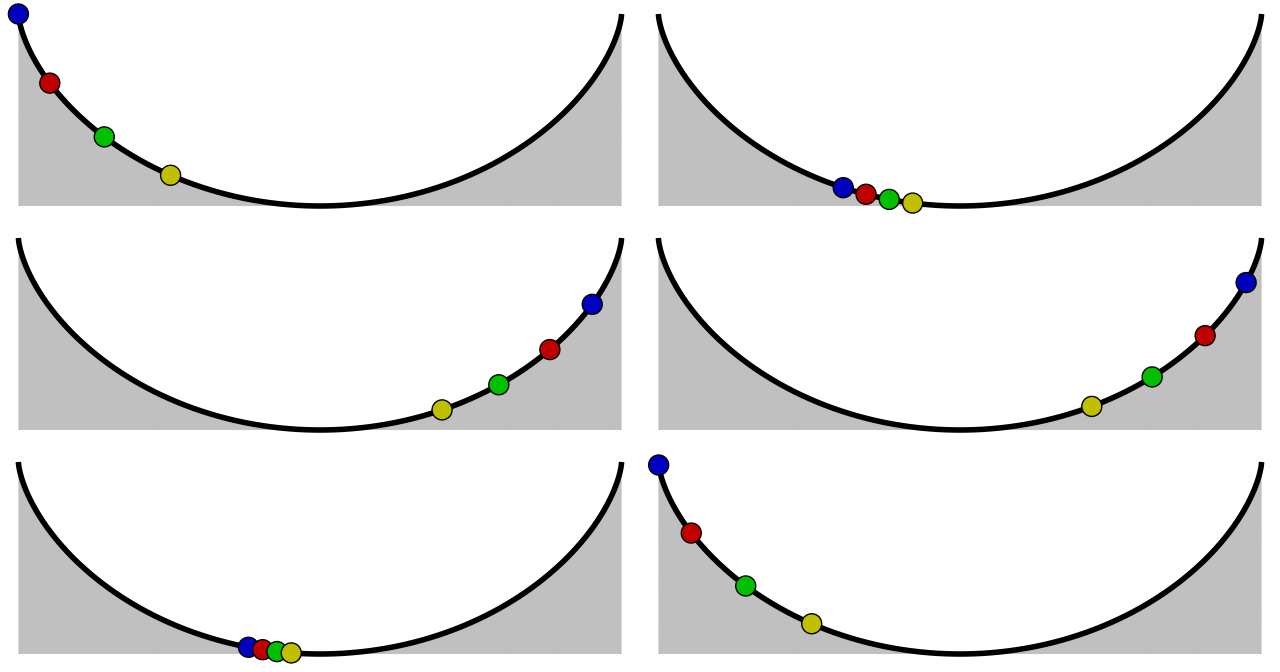
This property is *the* defining feature of harmonic oscillators - and the first “aha moment” of the story.
Part 2: Huygens’s cheeks.
Let’s make a pendulum more like a harmonic oscillator.
If the pendulum’s period does not depend on its mass or amplitude, then what does it depend on? Galileo found that the pendulum’s period was set by its length - but it was a purely empirical result. In the 1650s, Huygens took the next step of trying to understand why.
Through mathematical analysis, Huygens understood that Galileo’s property arises in a system where the force is proportional to the displacement (or angle) - and that the pendulum only satisfies this property for small swing angles.
In modern language, here the restoring force of a simple pendulum (blue arrow below) is given by
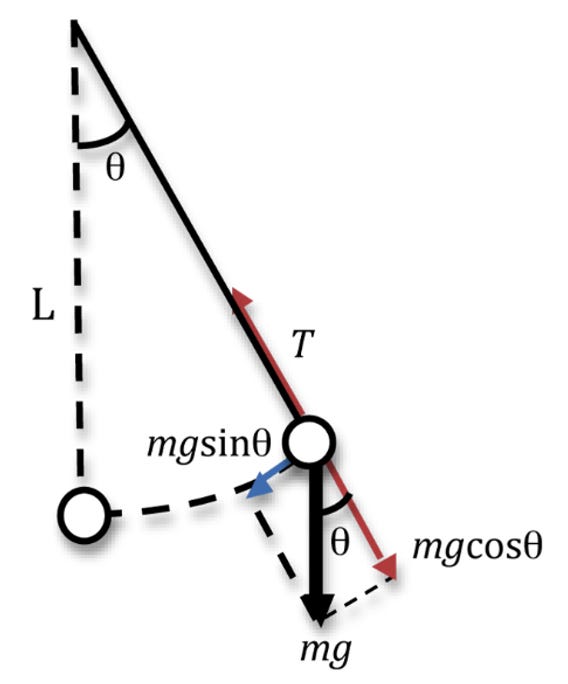
which, for small angles, linearises to a force F that is proportional to displacement
In this linear regime, the equation of motion is then given by
from which we can easily show that motion is a periodic oscillation with a frequency
that just depends on the pendulum’s length, but not its mass or amplitude.
However, because sin(θ) is not quite equal to θ - and the difference between the two grows as x grows - the simple pendulum is not quite a simple harmonic oscillator, and the difference between them grows with amplitude.
Thus, Huygens understood why the harmonic oscillator is a good model for a simple pendulum, but also why it’s an approximate one. And marked with this understanding, he decided to do something very very sneaky - to engineer a new pendulum that is more harmonic.
In a nutshell, it went like this. As amplitude theta increases, sin(θ) increases more slowly than θ, resulting in a frequency that decreases with amplitude. Huygens realised that one could compensate for that by making a pendulum that gets shorter with amplitude - in turn, making it more like the “ideal” SHO.
He achieved that through an ingenious solution - a pair of “cheeks” at the top of the pendulum.
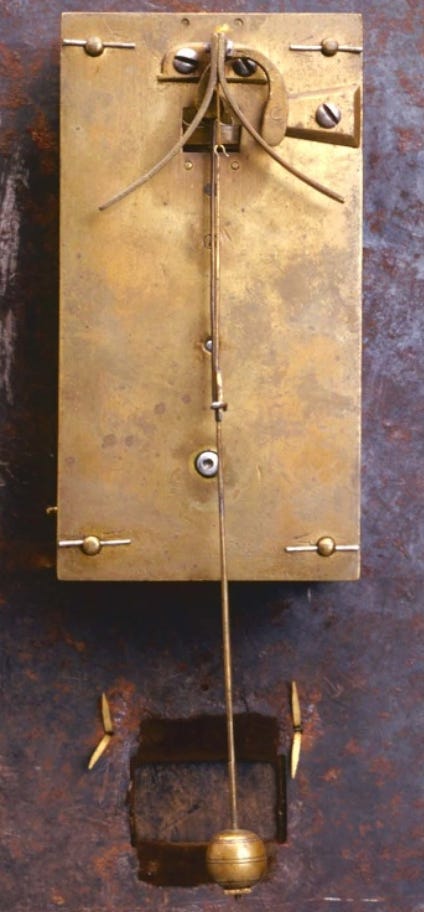
You can see the principle in action below. As the amplitude increases, an ever larger portion of the string is touching the cheek - meaning the free-hanging portion is shorter and shorter.
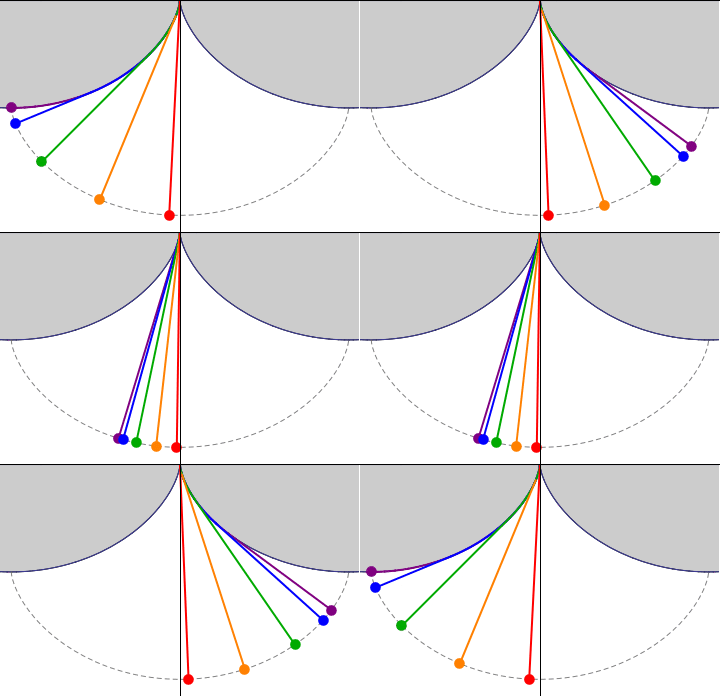
By precisely choosing the shape of the cheek, Huygens was able to make the most precise time-keeping pendulum of its time, starting the revolution of pendulum clocks that lasted for centuries.
See what he did there?
Come to think of it, even those early days already illustrate the unreasonable effectiveness of the harmonic oscillator. Did you see what happened?
Galileo modelled a pendulum as a harmonic oscillator
Huygens understood the limitations of that model
Huygens modified the pendulum to be even more like a harmonic oscillator
Thus, even in the early days, the SHO was more than an approximate model of reality - it was a goal aspire to.
But the story of the harmonic oscillators was just getting started, and little could Huygens anticipate just how far this abstraction could be applied!